in reply to Re^3: Perl regex speed
in thread Perl regex speed
|
|---|
| Replies are listed 'Best First'. | |
|---|---|
|
Re^5: Perl regex speed
by afoken (Chancellor) on Oct 27, 2022 at 11:00 UTC | |
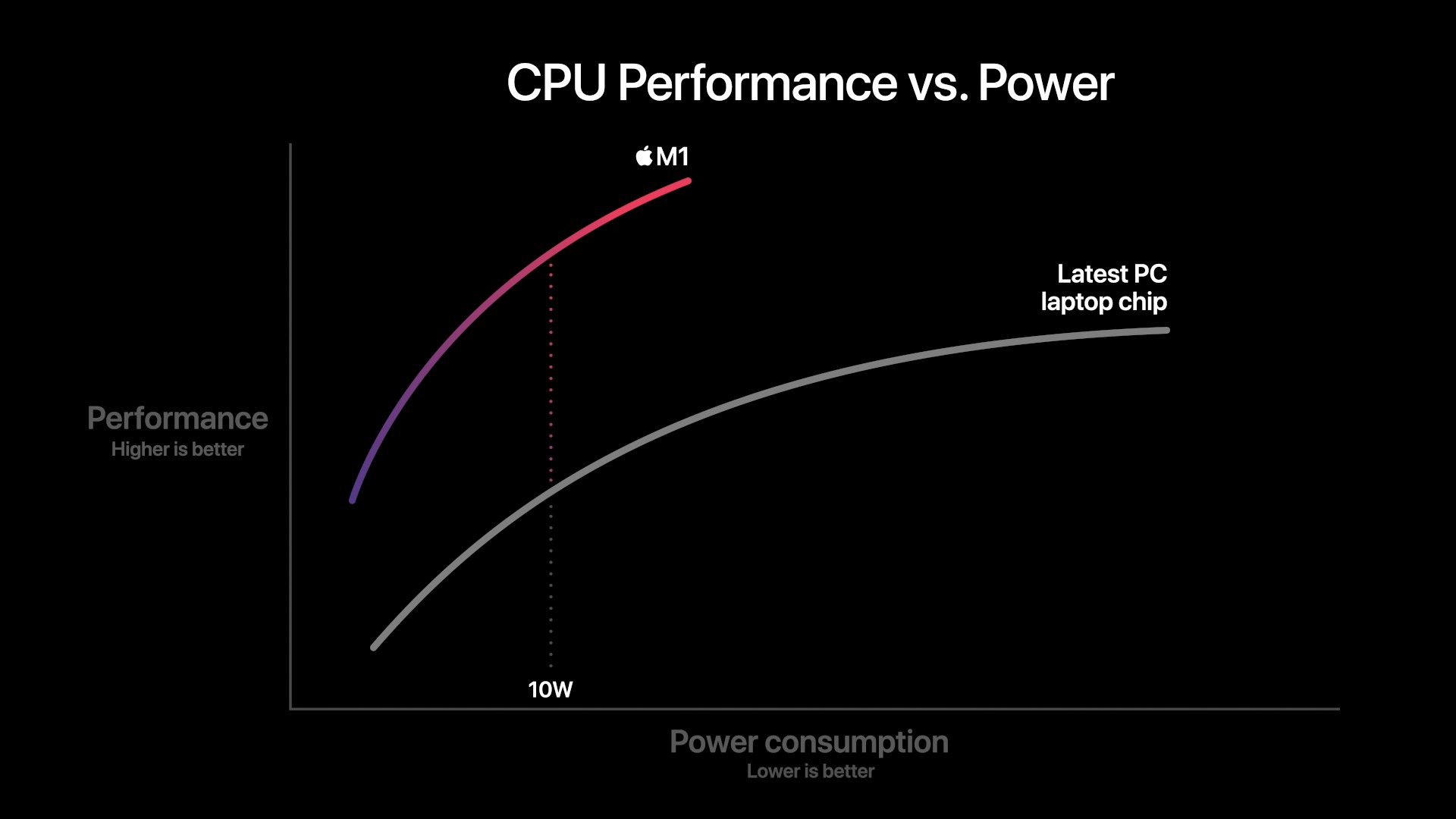
See for example Apple slide on Anantech Nicely drawn, but technically, the information content is close to zero. This is the kind of graphics you use to separate people with too much money and too little knowledge from their money. What information can we gain from the image? Quite obviously, the "Apple M1" is compared against the "latest PC laptop chip". According to the file name of the image, it is from November 2020, before the M1 Pro, M1 Max, and M1 Ultra were released. So this is old news, Apple, AMD and Intel have released new hardware with different power consumption and performance since then. If you want to test performance, you need to use hardware from November 2020, not from 2022. Comparing apples and oranges: The apple is clear, it's the original Apple M1. But what is the orange, the "latest PC laptop chip" in November 2020? Intel or AMD? Which model? There is simply no information in the image. Comparing apples and oranges, again: The Apple M1 is a System-on-a-chip, combining the CPU cores, lots of peripherals, and even the main RAM on the same chip. (Technically, the RAM is a sepearate chip on the same carrier.) This is more like a smartphone or tablet design and less like a PC/Laptop design. PCs, including laptops, keep the RAM separate, a lot of peripherals are in the south bridge of the chipset, older designs have CPU, memory and fast bus systems connected to the north bridge. Modern designs moved the memory controller from the north bridge to the CPU. Also, PCs still have lots of legacy hardware, including an LPC (low pin count) bus that looks and feels like a classic ISA bus to all software. Which parts are included in the power consumption, which are excluded? The X axis: We have exactly one X value, 10 W. Both the M1 and the "latest PC laptop chip" consume 10 W, or less, or more. How much less? How much more? We can't know, there is no second X value. We don't know if the X asis starts at 0 or some other value. Mathematically, it should start at 0, but in the real world, X and Y axes may have an offset. We can perhaps guess that the X asis starts at 0, because neither M1 nor the "latest PC laptop chip" have any performance at x=0. But we can't even guess where M1 or "latest PC laptop chip" power consumption start or end, because we don't now if the X asis is linear, logarithmic, exponential, or some other scaling. With some creative scaling, the top consumption of the two chips might differ only in a few Milliwatts, or by Kilowatts if scaled differently The Y asis: No Y values at all, not even a unit, like Floating point operations per second, Integer operations per second, benchmark points, whatever. This is even worse than the X axis. All problems of the X axis also apply. Unknown scaling, unknown origin. Again, with some creative scaling, the difference between the two chips might be down in the noise floor, or astronomic. Alexander
-- Today I will gladly share my knowledge and experience, for there are no sweeter words than "I told you so". ;-) | [reply] |
| |
|
Re^5: Perl regex speed
by soonix (Chancellor) on Oct 27, 2022 at 13:51 UTC | |
… which more or less overlaps with what Alexander said. | [reply] |
by malaigo (Novice) on Oct 28, 2022 at 03:44 UTC | |
| [reply] |
|
Re^5: Perl regex speed
by eyepopslikeamosquito (Archbishop) on Oct 27, 2022 at 04:24 UTC | |
Please do us all a favour and stop posting links to pretty pictures in .jpg files. I would much rather see links that describe in detail how the measurements were done, with full source code of the benchmark programs along with exactly how they were compiled and run, so that others can independently run the benchmarks for themselves. | [reply] |
by cavac (Prior) on Oct 27, 2022 at 11:45 UTC | |
If a plot is required, one can be easily done in a way the text-based forum supports it (as long as the screen width is sufficient):
I used Gnuplot to make this:
The magic line here is: set terminal dumb size 120,30
PerlMonks XP is useless? Not anymore: XPD - Do more with your PerlMonks XP
| [reply] [d/l] [select] |
by malaigo (Novice) on Oct 28, 2022 at 03:32 UTC | |
| [reply] |
by Bod (Parson) on Oct 28, 2022 at 11:43 UTC | |
stop posting links to pretty pictures Would you prefer pictures that are not pretty??? | [reply] |
by eyepopslikeamosquito (Archbishop) on Oct 28, 2022 at 23:24 UTC | |
Would you prefer pictures that are not pretty??? Sorry, I should have been clearer. I was not asking for pictures at all. I smelled an Apple Fanboy and the supporting pretty pictures looked more marketing than science to me. Given the OP claims to be a University professor, I was frankly astonished to see these pretty pictures being presented as evidence. I expected to see peer-reviewed academic papers, or at the very least, links than contain source code along with details of how the benchmarks were run, so they can be independently reviewed and verified by others. Update 28 Nov 2022: Noticed this Quora story in my inbox today asking: Why is the M1 chip in Mac far overrated over the core i9 11th generation? One random quote that caught my eye: There’s a war of words going on between Apple and Intel fanboys here. The raw performance of some Intel chips exceeds the performance of the M1 and M1 Pro. On performance per watt Apple wins hands down. | [reply] |
by Bod (Parson) on Oct 29, 2022 at 21:31 UTC | |
by LanX (Saint) on Oct 28, 2022 at 23:48 UTC | |
This is one of the fundamental conflicts software designers have, if they are asked by amateurs (aka bosses) to dumb down carefully designed interfaces into something prettier (sic). In this case: Charts look better with less text and appealing colors, but loose crucial information. E.g: I'm afraid the new metacpan interface is an example for sacrificing function for form.
Cheers Rolf °) Apparently this conflict is much older than IT and originates in architecture ... Makes sense :) | [reply] |
by eyepopslikeamosquito (Archbishop) on Oct 29, 2022 at 23:04 UTC | |
by LanX (Saint) on Oct 30, 2022 at 11:59 UTC | |
by Bod (Parson) on Oct 29, 2022 at 23:22 UTC | |
by Bod (Parson) on Oct 29, 2022 at 21:26 UTC | |