"Another guy stated that Python/Ruby are truly Object Oriented languages and it makes more sense to learn them."
This begs the question of whether a language has to be object-oriented to be worthwhile. Haskell (for example) is a very elegant programming language, but doesn't do OO at all.
And although Perl's built-in OO requires a little manual work, it's extremely flexible, supporting OO concepts like multiple inheritance that many other OO languages do not (including Ruby, Java and PHP).
It's flexible enough to build things like Moose on top of - and I'd argue that Moose offers a more powerful OOP framework than almost any other programming language. (Scala is probably the most mainstream programming language that offers OOP that rivals the Moose.)
"The question that's stuck in my mind though, is, why are people moving "away" from Perl?"
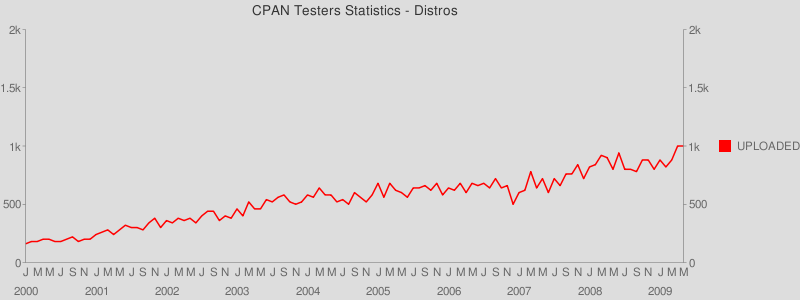
Don't believe the hype. Sure plenty of people are moving away from Perl, but many more than that seem to be moving towards it. Measuring such things as these directly is difficult, but there are proxy measurements.
In reply to Re: Migrating from Perl to other language? Why would someone do that?
by tobyink
in thread Migrating from Perl to other language? Why would someone do that?
by pmu
| For: | Use: | ||
| & | & | ||
| < | < | ||
| > | > | ||
| [ | [ | ||
| ] | ] |