in reply to Bit string manipulation made easy with Bit::Manip

While looking at the documentation to bit_set() to make sure my "not really necessary" was true, I had some thoughts:

Instead of calling the argument for the number of bits "$bits", I'd be tempted to document it as "$nbits"; some might want to misinterpret that argument name as a bit-mask instead of a number of bits, despite the text on the next line. (ie, when I first saw that, my mind set the "need more information flag" until I got to the next line. (This will especially help clarify if you end up implementing the next suggestion.)

With longer words, there have been times when I want to address multiple disjoint bits simultaneously, such as when a hardware designer separates bits that would logically be grouped. For example, suppose you had a register where in the cheap version of a part, you set a 4bit offset and an offset-enable, where the enable is in bit 4, and the 4 bit offset is bits[3:0] = offset[3:0]; but in a more expensive but pin-and-register compatible version, the same register has an additional 2 bits of offset above the sign bit, so it's bits[6:5] = offset[5:4], bits[4] = enable, bits[3:0] = offset[3:0]. (I design tests for hardware for a living; I've seen much more convoluted register words than that.) To that end, I would want

(I don't particularly like the _disjoint() naming convention... you might want to see if you can come up with a better one.)

Replies are listed 'Best First'.
Re^2: Bit string manipulation made easy with Bit::Manip
by stevieb (Canon) on Jan 30, 2017 at 22:17 UTC

    Thanks for the superb feedback based on the appreciated work you did reading through the docs and playing with the code!

    I'm just prototyping a new chip using this software almost exclusively for my bit-banging just to test how it works at the moment. I've found a few things that irk me that I'll be looking at changing, but after I'm done with the guts of this hardware and I have a bit schematic ready to write in C, I'll carefully review your node here and consider with what I've found and most likely do another update.

    As it stands, I'm getting some Testers failures on v5.6 anyhow (import wasn't exported from Exporter back then, so I think I need to declare a specific version of that dist, so a fix is in order anyhow. As an aside, I shouldn't have gone to v1.xx so quickly. Normally I give myself some time to ensure no API changes occur. It is what it is.

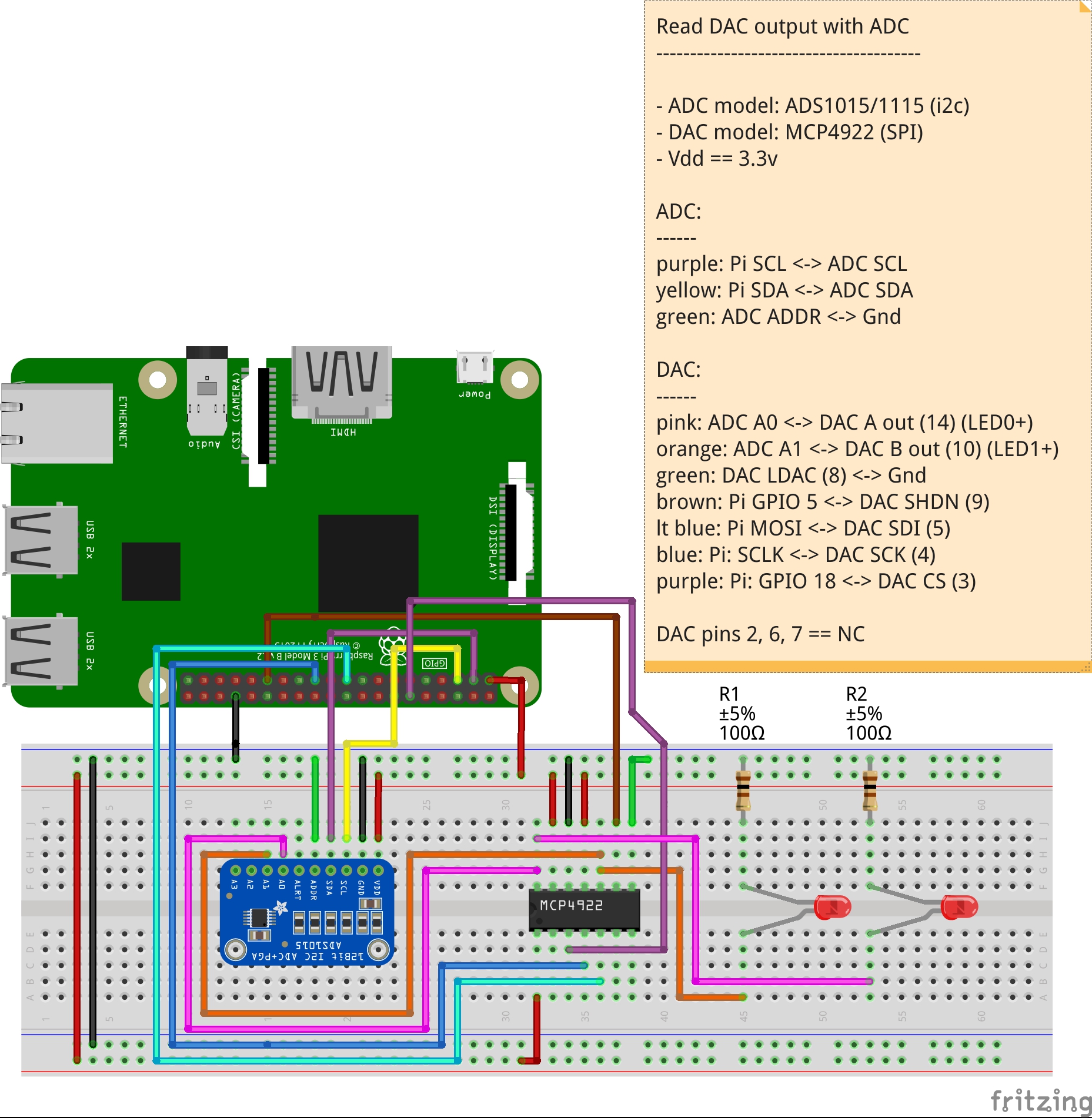
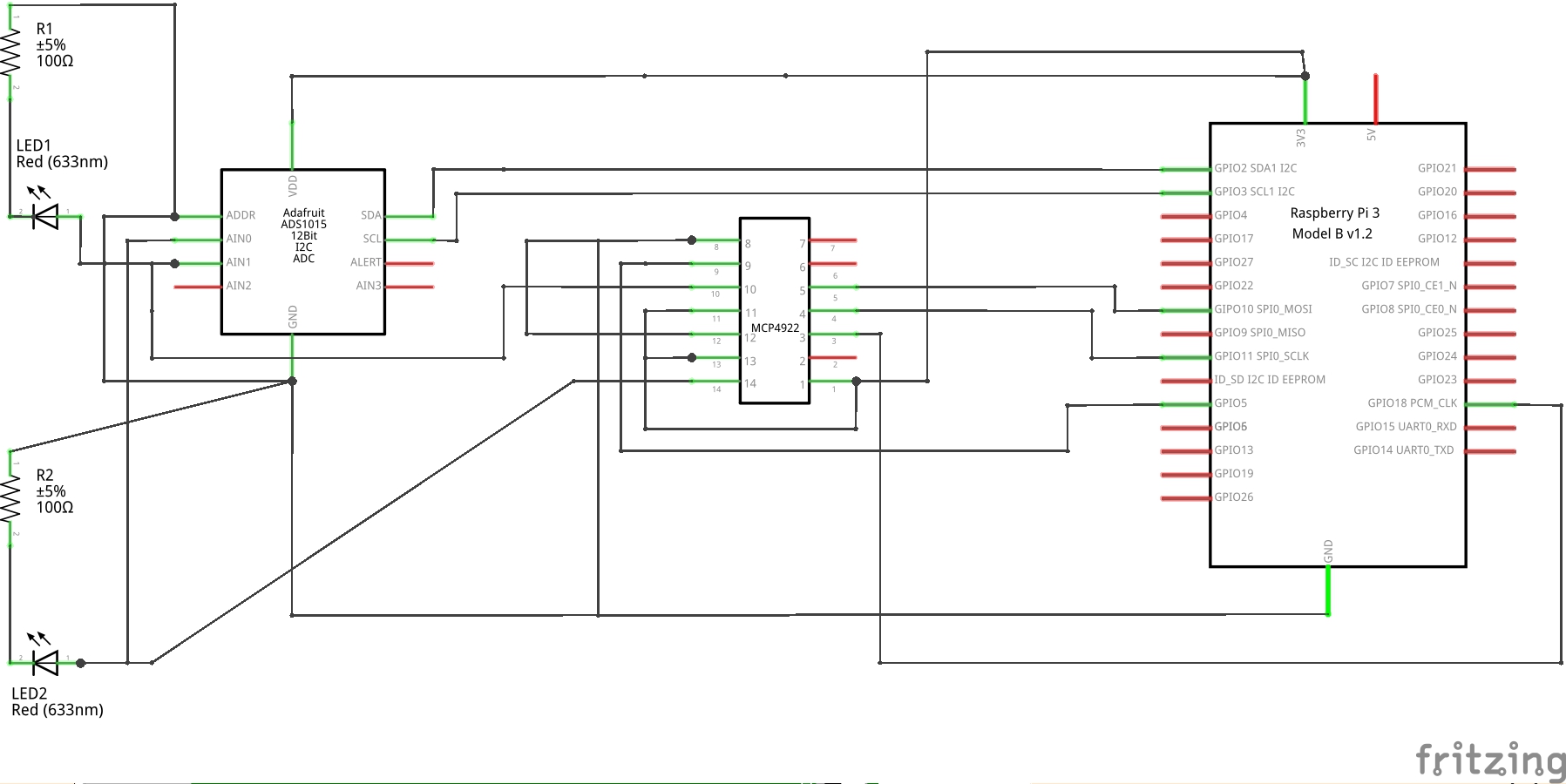
      First full IC prototype using Perl, with the Bit::Manip software for bit banging, worked out quite well. Now I'm just finishing up the C code that will take over the work, and publish the distribution for the MCP4922 (well, the MCP49x2) digital to analog converters.

      update: breadboard layout and schematic used for the prototype testing./update

      After that's complete, I'll be making some of the suggested updates to Bit::Manip. Again, thanks for the feedback everyone!

      use warnings; use strict; use feature 'say'; use Bit::Manip qw(:all); use RPi::WiringPi; use RPi::WiringPi::Constant qw(:all); my $spi_chan = 0; my $pi = RPi::WiringPi->new; my $adc = $pi->adc; my $spi = $pi->spi($spi_chan); my $cs_pin = $pi->pin(18); my $shdn_pin = $pi->pin(6); # light up some pins per the datasheet # device channel select (CS) to HIGH, in case the # device started it as LOW. In this case, we # bit-bang the CS pin, instead of using the # hardware SPI $cs_pin->mode(OUTPUT); $cs_pin->write(HIGH); # device 'shutdown' (SHDN) pin we'll tie to HIGH, # when tied to HIGH, means all DACs active $shdn_pin->mode(OUTPUT); $shdn_pin->write(HIGH); # show the current voltage output % on both DAC # channels before we begin say $adc->percent(0); say $adc->percent(1); # dac 0 say "\nDAC 0...\n"; dac_write(0, [0b1111, 0b11111111]); say "dacA: " . $adc->percent(0) . "%"; dac_write(0, [0b0111, 0b0]); say "dacA: " . $adc->percent(0) . "%"; dac_write(0, [0b0, 0b0]); say "dacA: " . $adc->percent(0) . "%"; # dac 1 say "\nDAC 1...\n"; dac_write(1, [0b1111, 0b11111111]); say "dacB: " . $adc->percent(1) . "%"; dac_write(1, [0b0111, 0b0]); say "dacB: " . $adc->percent(1) . "%"; dac_write(1, [0b0, 0b0]); say "dacB: " . $adc->percent(1) . "%"; sub dac_write { my ($dac, $data) = @_; die "\$dac param must be 0 or 1\n" if $dac != 0 && $dac != 1; # init the register my $register = [0, 0]; # DAC (bit 7) (a/b == 0/1) we're writing to $register->[0] = bit_set($register->[0], 7, 1, $dac); # BUFFERING (bit 6) == 0 $register->[0] = bit_set($register->[0], 6, 1, 0); # GAIN (bit 5) == 1 $register->[0] = bit_on($register->[0], 5); # SHDN (shutdown) (bit 4) == 1 $register->[0] = bit_set($register->[0], 4, 1, 1); # DATA (bits 3-0) $register->[0] = bit_set($register->[0], 0, 4, $data->[0]); say "byte1: ".bit_bin($register->[0]); # DATA byte 2 $register->[1] = bit_set($register->[1], 0, 8, $data->[1]); say "byte2: ".bit_bin($register->[1]); # drop chip select to LOW to start conversation with the DAC $cs_pin->write( LOW ); # write our bytes to the SPI bus $spi->rw($register, 2); # go HIGH to tell the IC we're done clocking in bits $cs_pin->write( HIGH ); } $pi->cleanup;

      output:

      0.00 0.00 DAC 0... byte1: 111111 byte2: 11111111 dacA: 99.94% byte1: 110111 byte2: 0 dacA: 43.76% byte1: 110000 byte2: 0 dacA: 0.00% DAC 1... byte1: 10111111 byte2: 11111111 dacB: 100.00% byte1: 10110111 byte2: 0 dacB: 43.70% byte1: 10110000 byte2: 0 dacB: 0.00%
Re^2: Bit string manipulation made easy with Bit::Manip
by stevieb (Canon) on Feb 01, 2017 at 20:16 UTC

    I've done a mock up of what I think you're after. The function that handles the out of order sequence is bit_set_seq() below, and the one that'll handle missing bits (and leave them as is) is bit_set_skip(). Let me know if the output is what you expected. The implementation details aren't really relevant right now, as I just wanted to ensure the output was correct before I made it better.

    use warnings; use strict; use feature 'say'; use Bit::Manip qw(:all); # out of order sequence for (0..11){ bit_set_seq(0x00, [3, 1, 2, 0], $_); } # skip over for (0..11){ my $b = $_; $b = bit_on($b, 1); $b = bit_on($b, 2); bit_set_skip($b, [0, 3], $_); } sub bit_set_seq { my ($b, $seq, $val) = @_; my $lsb = (sort @$seq)[0]; my $msb = (sort @$seq)[-1]; my $nbits = ($msb - $lsb); $b = bit_set($b, $lsb, $nbits, $val); say "** $val"; printf("seq before: %b\n", $b); my $x = $b; for (0..$nbits){ my $o = bit_get($b, $_, $_); my $s = bit_get($b, $seq->[$_], $seq->[$_]); if ($o != $s){ $x = bit_set($x, $_, 1, $s); } } printf("seq after %b\n\n", $x); } sub bit_set_skip { my ($b, $seq, $val) = @_; my $lsb = (sort @$seq)[0]; my $msb = (sort @$seq)[-1]; my @leave_bits = map $seq->[$_-1]+1..$seq->[$_]-1, 1..@$seq-1; my %leave_vals = map {$_ => bit_get($b, $_, $_)} @leave_bits; my $nbits = ($msb - $lsb) + 1; $b = bit_set($b, $lsb, $nbits, $val); say "** $val"; printf("skip before: %b\n", $b); for (keys %leave_vals){ $b = bit_set($b, $_, 1, $leave_vals{$_}); } printf("skip after: %b\n\n", $b); }

    output:

    ** 0 seq before: 0 seq after 0 ** 1 seq before: 1 seq after 1000 ** 2 seq before: 10 seq after 10 ** 3 seq before: 11 seq after 1010 ** 4 seq before: 100 seq after 100 ** 5 seq before: 101 seq after 1100 ** 6 seq before: 110 seq after 110 ** 7 seq before: 111 seq after 1110 ** 8 seq before: 1000 seq after 1 ** 9 seq before: 1001 seq after 1001 ** 10 seq before: 1010 seq after 11 ** 11 seq before: 1011 seq after 1011 ** 0 skip before: 0 skip after: 110 ** 1 skip before: 1 skip after: 111 ** 2 skip before: 10 skip after: 110 ** 3 skip before: 11 skip after: 111 ** 4 skip before: 100 skip after: 110 ** 5 skip before: 101 skip after: 111 ** 6 skip before: 110 skip after: 110 ** 7 skip before: 111 skip after: 111 ** 8 skip before: 1000 skip after: 1110 ** 9 skip before: 1001 skip after: 1111 ** 10 skip before: 1010 skip after: 1110 ** 11 skip before: 1011 skip after: 1111

      I'm not sure I correctly interpreted your intended API on bit_set_seq(), and I know I didn't on bit_set_skip.

      For bit_set_seq(), I interpreted the index to the array-ref as the bit number of the output, and the value at that index as the bit number for the input. If you intended the other way around, my tests below should work for exp0123 and exp3210, but won't be right for exp0312. But since my tests are completely failing, there's probably something I'm missing about the way you intended it to be used.

      use Bit::Manip qw(:all); use Test::More; # out of order sequence my @exp0123 = (0..15); my @exp3210 = reverse(0..15); my @exp0312 = (0b0000,0b0001,0b0100,0b0101,0b1000,0b1001,0b1100,0b1101 +,0b0010,0b0011,0b0110,0b0111,0b1010,0b1011,0b1110,0b1111); for (0 .. 15) { is( bit_set(0x00, 2, 4, $_), $_ << 2, "nomal set, shifted up 2" ); is( bit_set_seq(0x00, [0,1,2,3], $_), $exp0123[$_], "[0,1,2,3]: I +expect bit 0 [LSB] of input to be transferred to bit 0 [LSB] of outpu +t -- ie, same order"); is( bit_set_seq(0x00, [3,2,1,0], $_), $exp3210[$_], "[3,2,1,0]: I +expect bit 3 [MSB] of input to be transferred to bit 0 [LSB] of outpu +t, in2 -> out1, in1 -> out2, in0 -> out3 -- ie, reverse the bits"); is( bit_set_seq(0x00, [0,3,1,2], $_), $exp0312[$_], "[0,3,1,2]: I +expect in0 -> out0, in3->out1, in1->out2, in2->out3"); } ... # your subs go below, not quoted here...

      For bit_set_skip, I couldn't interpret it at all... What I would want would be a feature where I could put arbitrary gaps, for example, $out = bit_set_skip( $in, $seq, $val ). I would want to break $val into chunks based on seq, and put it into $in to create out. For this table: K means "keep the same bit value as in input", whereas a 1 or 0 means that I want that value there, regardless of what was originally in INPUT. I couldn't figure out the $seq necessary to do this, but below my table is the API I would have guessed to set this...

      # INPUT VAL DESIRED OUTPUT # 0bKKKK_KKKK 0b0000_0000 0bKKK0_K000 # 0bKKKK_KKKK 0b0000_0001 0bKKK0_K001 # 0bKKKK_KKKK 0b0000_0010 0bKKK0_K010 # 0bKKKK_KKKK 0b0000_0011 0bKKK0_K011 # 0bKKKK_KKKK 0b0000_0100 0bKKK0_K100 # 0bKKKK_KKKK 0b0000_0101 0bKKK0_K101 # 0bKKKK_KKKK 0b0000_0110 0bKKK0_K110 # 0bKKKK_KKKK 0b0000_0111 0bKKK0_K111 # 0bKKKK_KKKK 0b0000_1000 0bKKK1_K000 # 0bKKKK_KKKK 0b0000_1001 0bKKK1_K001 # 0bKKKK_KKKK 0b0000_1010 0bKKK1_K010 # 0bKKKK_KKKK 0b0000_1011 0bKKK1_K011 # 0bKKKK_KKKK 0b0000_1100 0bKKK1_K100 # 0bKKKK_KKKK 0b0000_1101 0bKKK1_K101 # 0bKKKK_KKKK 0b0000_1110 0bKKK1_K110 # 0bKKKK_KKKK 0b0000_1111 0bKKK1_K111 for (0 .. 15) { is( bit_set_skip( 0x00, [0,1,2,4], $_), (($_ & 0x08)<<1) | (($_ & +0x07)<<0), "put a gap between the MSB and the lower three bits"); }

        I didn't quite grasp what you were after, but I think I have a bit better of an idea now. As I said, most of this stuff is new to me. Besides, I haven't run into a register with offset bits and such, so this is another new rabbit hole :)

        I'll review this and play around, and if I have questions, I'll send a /msg. Thanks!