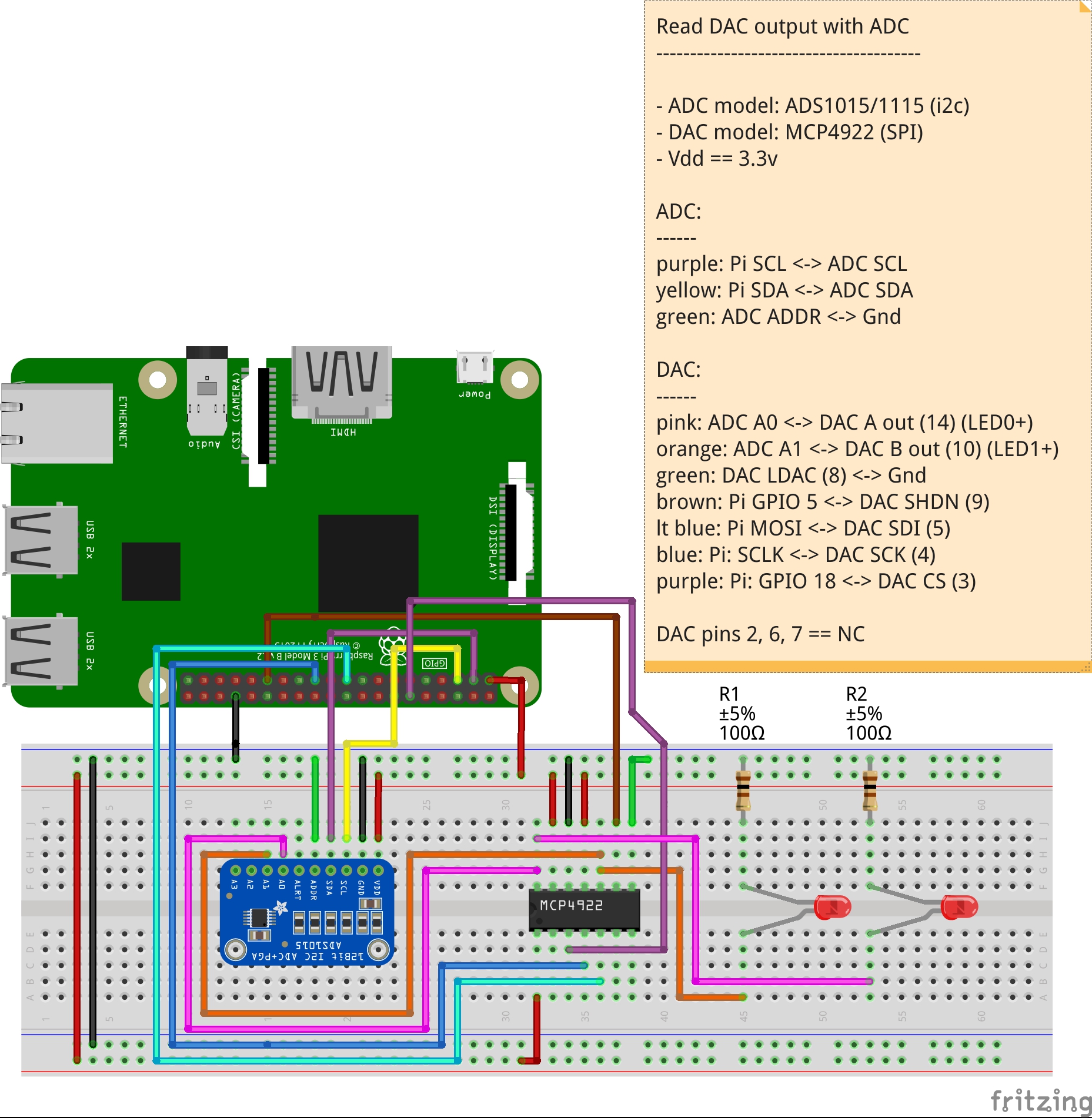
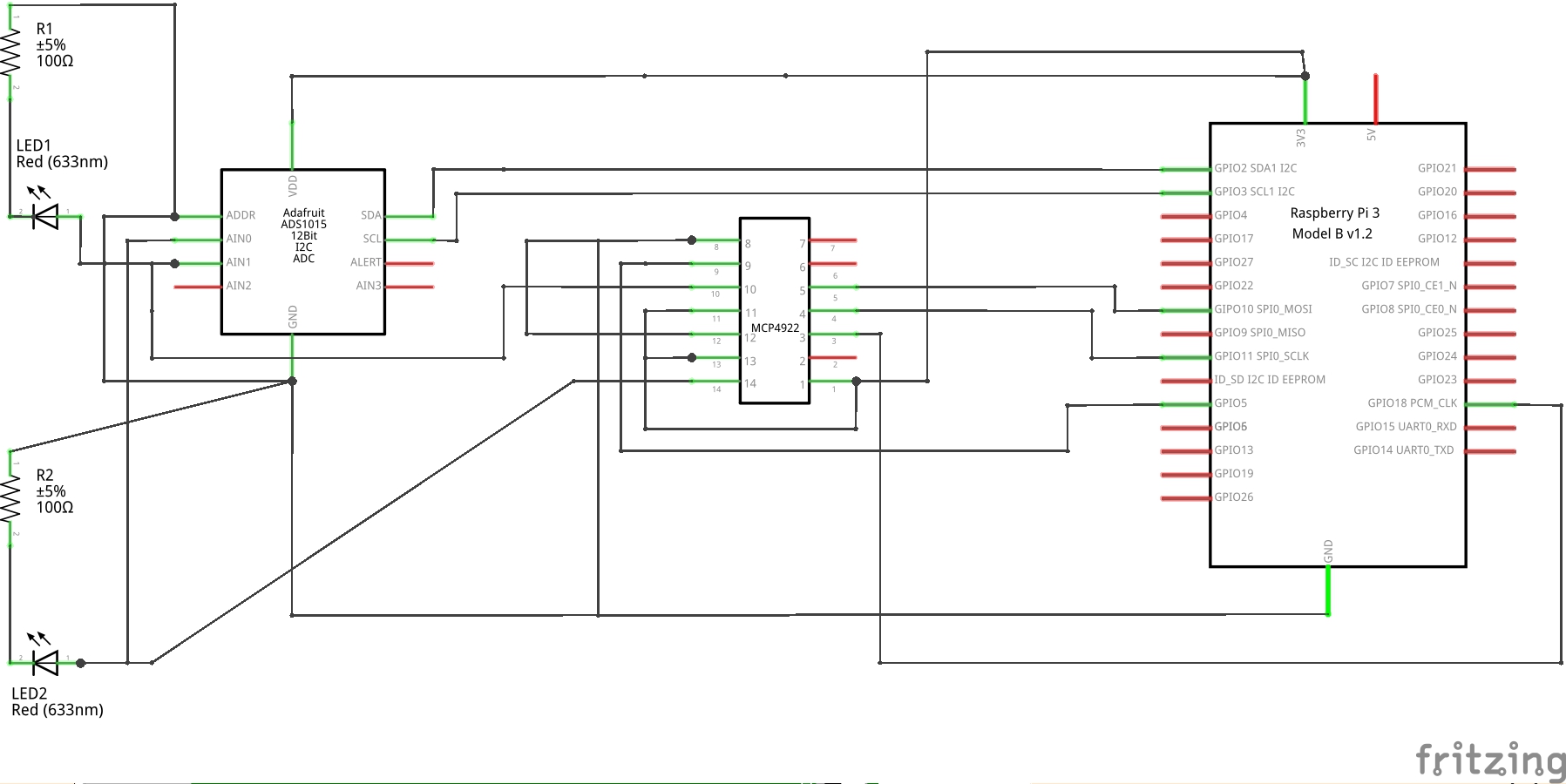
First full IC prototype using Perl, with the Bit::Manip software for bit banging, worked out quite well. Now I'm just finishing up the C code that will take over the work, and publish the distribution for the MCP4922 (well, the MCP49x2) digital to analog converters.
update: breadboard layout and schematic used for the prototype testing./update
After that's complete, I'll be making some of the suggested updates to Bit::Manip. Again, thanks for the feedback everyone!
use warnings;
use strict;
use feature 'say';
use Bit::Manip qw(:all);
use RPi::WiringPi;
use RPi::WiringPi::Constant qw(:all);
my $spi_chan = 0;
my $pi = RPi::WiringPi->new;
my $adc = $pi->adc;
my $spi = $pi->spi($spi_chan);
my $cs_pin = $pi->pin(18);
my $shdn_pin = $pi->pin(6);
# light up some pins per the datasheet
# device channel select (CS) to HIGH, in case the
# device started it as LOW. In this case, we
# bit-bang the CS pin, instead of using the
# hardware SPI
$cs_pin->mode(OUTPUT);
$cs_pin->write(HIGH);
# device 'shutdown' (SHDN) pin we'll tie to HIGH,
# when tied to HIGH, means all DACs active
$shdn_pin->mode(OUTPUT);
$shdn_pin->write(HIGH);
# show the current voltage output % on both DAC
# channels before we begin
say $adc->percent(0);
say $adc->percent(1);
# dac 0
say "\nDAC 0...\n";
dac_write(0, [0b1111, 0b11111111]);
say "dacA: " . $adc->percent(0) . "%";
dac_write(0, [0b0111, 0b0]);
say "dacA: " . $adc->percent(0) . "%";
dac_write(0, [0b0, 0b0]);
say "dacA: " . $adc->percent(0) . "%";
# dac 1
say "\nDAC 1...\n";
dac_write(1, [0b1111, 0b11111111]);
say "dacB: " . $adc->percent(1) . "%";
dac_write(1, [0b0111, 0b0]);
say "dacB: " . $adc->percent(1) . "%";
dac_write(1, [0b0, 0b0]);
say "dacB: " . $adc->percent(1) . "%";
sub dac_write {
my ($dac, $data) = @_;
die "\$dac param must be 0 or 1\n" if $dac != 0 && $dac != 1;
# init the register
my $register = [0, 0];
# DAC (bit 7) (a/b == 0/1) we're writing to
$register->[0] = bit_set($register->[0], 7, 1, $dac);
# BUFFERING (bit 6) == 0
$register->[0] = bit_set($register->[0], 6, 1, 0);
# GAIN (bit 5) == 1
$register->[0] = bit_on($register->[0], 5);
# SHDN (shutdown) (bit 4) == 1
$register->[0] = bit_set($register->[0], 4, 1, 1);
# DATA (bits 3-0)
$register->[0] = bit_set($register->[0], 0, 4, $data->[0]);
say "byte1: ".bit_bin($register->[0]);
# DATA byte 2
$register->[1] = bit_set($register->[1], 0, 8, $data->[1]);
say "byte2: ".bit_bin($register->[1]);
# drop chip select to LOW to start conversation with the DAC
$cs_pin->write( LOW );
# write our bytes to the SPI bus
$spi->rw($register, 2);
# go HIGH to tell the IC we're done clocking in bits
$cs_pin->write( HIGH );
}
$pi->cleanup;
output:
0.00
0.00
DAC 0...
byte1: 111111
byte2: 11111111
dacA: 99.94%
byte1: 110111
byte2: 0
dacA: 43.76%
byte1: 110000
byte2: 0
dacA: 0.00%
DAC 1...
byte1: 10111111
byte2: 11111111
dacB: 100.00%
byte1: 10110111
byte2: 0
dacB: 43.70%
byte1: 10110000
byte2: 0
dacB: 0.00%
|